
Public-record method demonstration
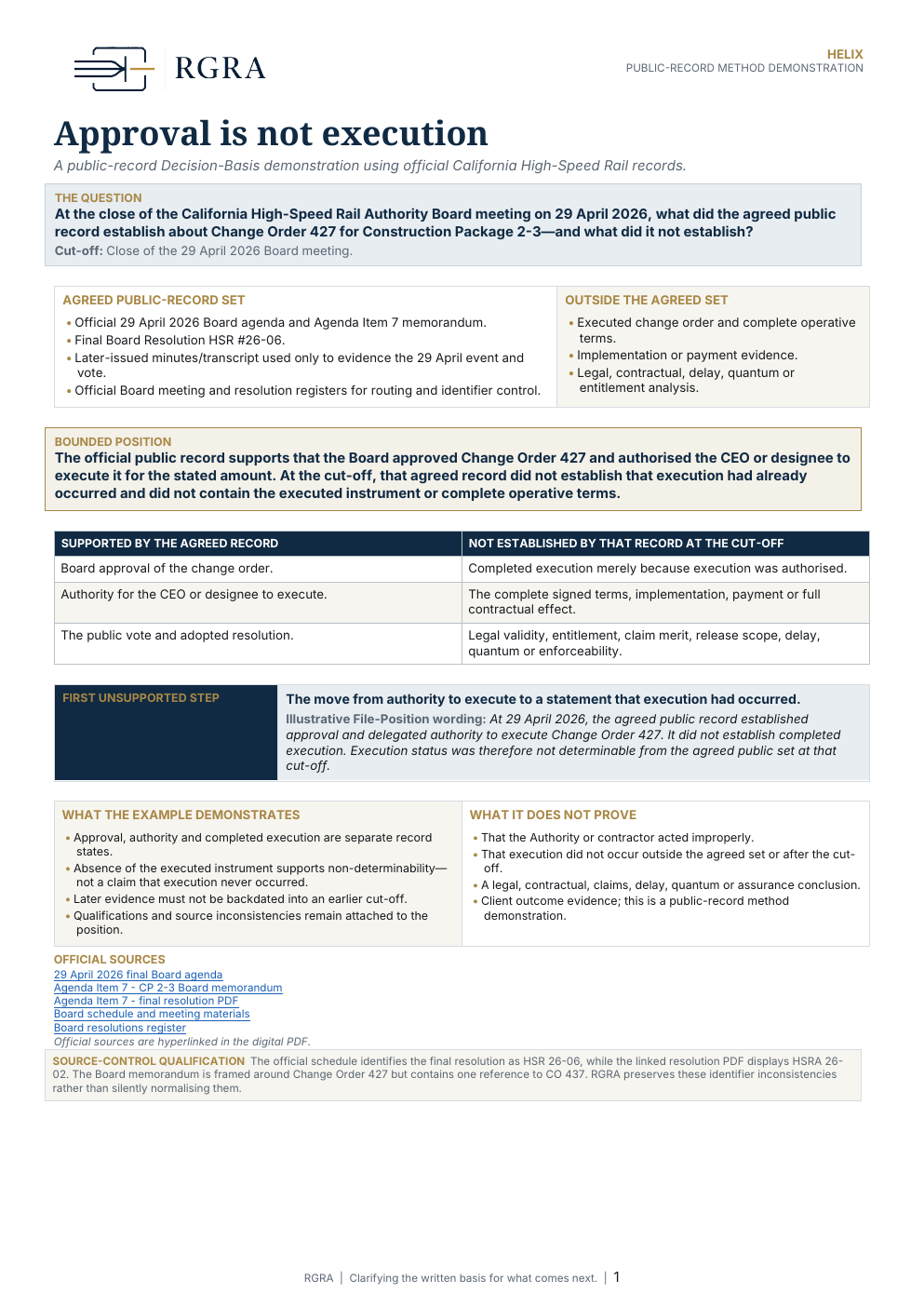
Approval is not execution
California High-Speed Rail records: what board approval and authority to execute established at the cut-off — and what they did not yet establish.
Open HELIXDecision-Basis Reviews · For expert & advisory teams and project decision owners
RGRA takes a defined documentary workstream within or alongside your expert engagement. We propose the questions for written approval and deliver a source-linked File-Position Note your team can inspect, challenge or correct.
Free initial, non-confidential fit screen. No files, analysis or promised savings at first contact. No software to install.

A defined workstream, not another open-ended report
RGRA can propose several candidate questions. Only the selected, expressly approved question(s) enter the paid review; additional work requires its own agreed scope.
What this looks like in practice
An official public record showed board approval and authority to execute a change order. The agreed set did not establish completed execution at the defined cut-off. RGRA identifies that documentary boundary; it does not decide contractual entitlement.
Independent public-record method demonstration — not a client commission or measured savings claim.
Who may commission a review
Experts and project teams can describe the uncertainty in ordinary terms. RGRA proposes the documentary questions and an appropriate bounded route; the instructing party approves any actual review before work begins.
You describe the unresolved record issue in an active commission. RGRA may propose a separately scoped documentary workstream within or alongside that commission. Your firm keeps its client, professional mandate, supervision and expert conclusion.
Tell us what is unclear before the next decision, instruction or hand-off. You do not need to supply a ready-made question. RGRA can propose one or more candidate questions for your written selection and scope approval.
Where the review stops — and why
RGRA states the source-supported written position available from the agreed record. Legal, technical, commercial, operational, assurance and expert functions retain the judgement they are authorised and competent to make.
No-duplication gate
If an adequate source-supported position is already expressly owned, produced and appropriately reviewed for the same decision, cut-off, audience and use, no parallel RGRA review is required.
Public-record method demonstrations
These are independent public-record demonstrations of method — not client case studies, outcomes or performance claims.
California High-Speed Rail records: what board approval and authority to execute established at the cut-off — and what they did not yet establish.
Open HELIX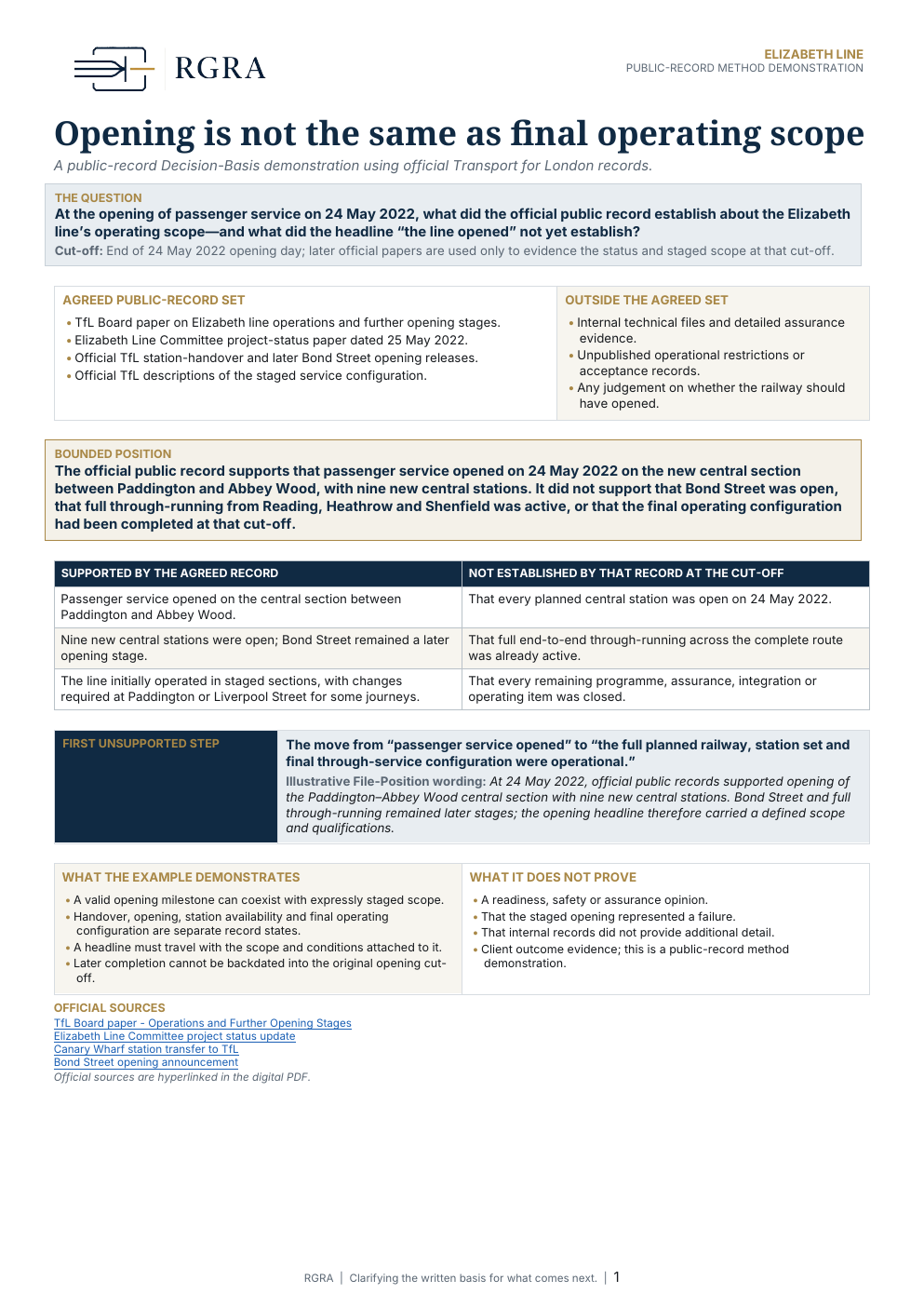
Transport for London records: how an opening milestone can be valid while the final station and through-running scope remain later stages.
Open Elizabeth LineControlled delivery
Matter acceptance, material conclusions and final release remain founder-controlled.